How to Choose a Rough Terrain Pallet Truck in 2026?
Choosing a Rough Terrain Pallet Truck in 2026 requires more than comparing prices or advertised lifting capacities. Outdoor warehouses, farms, construction sites, and timber yards create difficult working conditions. Uneven gravel, wet soil, narrow access routes, and sudden slopes can expose weak equipment quickly. A truck that performs well on concrete may struggle badly outside.
Warehouse management expert Ken Ackerman offers a useful principle: “Equipment should fit the work, not force the work to fit the equipment.” This idea should guide every purchasing decision. Buyers need to examine load weight, pallet dimensions, ground clearance, wheel design, braking control, and operator visibility. A 2,000-kilogram capacity sounds impressive, but it may not reflect safe performance on loose ground.
Real conditions matter.
Experienced operators often notice details that product brochures overlook. Can the steering handle a muddy turn? Does the handle remain stable when gloves are wet? Can the wheels cross a shallow rut without jolting the load? These questions reveal practical quality. Battery performance also deserves attention, especially during cold mornings or extended outdoor shifts. Some specifications may look convincing, yet still feel incomplete without field testing.
This guide explains how to compare a Rough Terrain Pallet Truck for 2026 applications. It considers safety, durability, maintenance access, traction, and total operating cost. The “best” model is not always the strongest one. Sometimes, a simpler truck with better balance and service support proves more reliable. Buyers should remain critical, because real sites rarely behave like showroom floors.
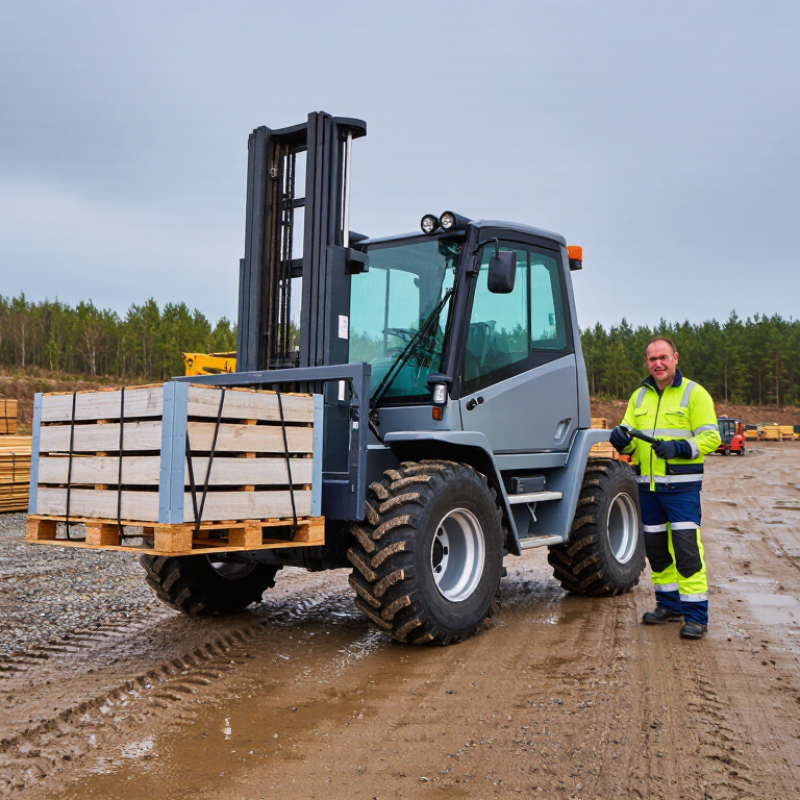
Define the Job: Terrain, Load, Travel Distance, and 2026 Duty Cycle
How to Choose a Rough Terrain Pallet Truck in 2026?
Define the job before comparing equipment. Measure the terrain, load, travel distance, and daily duty cycle. A gravel yard is not the same as a wet construction site. Note slopes, potholes, loose stone, doorway widths, and turning space. OSHA’s Powered Industrial Trucks eTool reports about 85 forklift-related deaths and 34,900 serious injuries annually in the United States. That makes stability and operator visibility practical priorities, not optional features.
Record the heaviest pallet, its center of gravity, and the highest lifting point. Then measure the longest one-way trip. A 500-meter route can create more fatigue than a heavier, short transfer. Check rated capacity on the actual surface, not only on a smooth warehouse floor. Pneumatic tires, ground clearance, braking control, and sealed electrical parts may matter more than headline lifting capacity. They matter outside.
MHI’s 2024 Annual Industry Report found that 55% of respondents planned to increase supply-chain technology investment. That does not automatically justify automation. A rough terrain pallet truck may face irregular loads, changing routes, and long idle periods. Estimate starts per hour, operating hours per shift, charging access, and seasonal peaks. Leave honest allowance for rain and delays. My first estimate is often too optimistic. Recheck it with operators after a full shift. A machine that survives the specification sheet may still feel wrong on Tuesday afternoon.
How to Choose a Rough Terrain Pallet Truck in 2026?
Define the job by terrain, load, travel distance, and daily duty cycle.
Use the profile closest to your site conditions when specifying a truck. Heavier loads, uneven surfaces, longer travel distances, and higher daily cycles require stronger traction, larger ground clearance, improved braking, and a higher-capacity battery. The figures are practical planning references; confirm final specifications with an on-site test.
Compare 2,200–3,000 lb Capacities, Ground Clearance, and Wheel Designs
Choosing a rough terrain pallet truck in 2026 starts with the load, not the advertising claim. Most models offer 2,200 to 3,000 pounds of capacity, but uneven ground changes real performance. A 2,200-pound truck may suit compact loads and short transfers. Heavier 3,000-pound units provide more reserve, especially when pallets are wet or slightly unbalanced. Yet extra capacity often adds weight and reduces easy maneuverability. Check the actual load center. A rating may fall when the load extends beyond the fork length.
Ground clearance deserves careful attention. Six inches can help a truck pass over gravel, shallow ruts, and damaged concrete. More clearance is useful outdoors, but it can raise the forks and affect stability on slopes. Measure your route before buying. A truck that clears a stone may still strike a doorway threshold. I have seen specifications look impressive while the turning space proved unsuitable.
Tips: Match wheel design to the surface. Large pneumatic wheels absorb loose gravel and small bumps, while solid rubber wheels resist punctures and need less maintenance. Polyurethane wheels roll smoothly on firm floors but may struggle in mud or deep gravel. Consider wheel width, tread depth, and replacement access. Test the loaded truck if possible. That step is often skipped. Also inspect handle reach, braking control, and frame welds. A capacity label cannot reveal every weakness, and real terrain can be less forgiving than the warehouse test area.
Evaluate Stability Using Load Centers, Gradients, and ANSI/ITSDF B56.9
A rough terrain pallet truck can feel stable on flat ground yet become unpredictable with a raised load.
Evaluate the load center before comparing rated capacity. Measure from the fork face to the load’s center of gravity. A 1,200-kilogram load centered 600 millimeters forward creates a greater overturning moment than the same load centered 400 millimeters forward. Uneven pallets, long forks, and shifting cartons can increase that distance without warning.
Gradients deserve a practical test, not a brochure estimate. Check the route’s slope, crossfall, loose gravel, drainage channels, and transition points. Travel with the load low, keep the heavier end uphill, and watch for steering response during braking. A short site trial is valuable. Still, one dry-day test can mislead. Wet soil may reduce traction sharply, while a side slope can shift the load center sideways. Recheck stability with the largest realistic pallet, not an idealized test load.
Use ANSI/ITSDF B56.9 as a professional safety reference for applicable rough-terrain forklift requirements, and confirm the exact scope with qualified safety personnel. Review rated capacity charts, inspection procedures, operator visibility, braking performance, and slope limitations. Do not treat standard language as permission to exceed the truck’s instructions. A competent evaluator should document measurements, surface conditions, and test results. Small details matter. A damaged pallet or a poorly centered load may expose weaknesses that a capacity plate cannot show.
Check ISO 3691-1 Safety Features, Braking, Steering, and Operator Controls
How to Choose a Rough Terrain Pallet Truck in 2026?
A rough terrain pallet truck must be checked beyond lifting capacity. ISO 3691-1 emphasizes verified safety functions, stability, braking, steering, and operator controls. Confirm that the selected machine’s exact configuration falls within the standard’s scope. Rough ground can hide risks. Loose gravel, slopes, and wet loading areas increase stopping distance.
The U.S. OSHA estimates that powered industrial trucks cause about 35,000 serious injuries and 62,000 non-serious injuries annually. The UK HSE also reports that workplace transport contributes to roughly one-quarter of workplace fatal injuries. These figures justify practical checks.
Test service and parking brakes with a loaded pallet. Steering should remain predictable at low speed. Check emergency-stop access, warning signals, horn, reverse alarms, and deadman controls. Controls should be reachable without twisting. Small details matter.
Tips
- Walk the test route before buying.
- Measure stopping distance on your worst surface.
- Inspect tyre grip, ground clearance, and load stability.
- Ask for documented ISO conformity and maintenance records.
- Do not trust brochure figures alone.
A larger battery is not automatically safer. In my view, operator feedback should influence the final choice, although workers may overlook risks during busy shifts. Recheck their comments after a supervised trial.
Caution is sometimes slower. That is acceptable.
Calculate Lifecycle Cost from Battery Runtime, Maintenance, and Downtime
How to Choose a Rough Terrain Pallet Truck in 2026?
A low purchase price can hide an expensive working life. Calculate lifecycle cost from energy, maintenance, battery replacement, and downtime. The U.S. Department of Energy’s Operations and Maintenance Best Practices Guide recommends tracking labor, parts, failure history, and lost operating time. Use those categories in one spreadsheet. A simple formula is: purchase cost plus energy, maintenance, replacement parts, and downtime.
Battery runtime deserves a field test, not just a brochure rating. Record runtime with the intended load, slope, surface, temperature, and tire pressure. A six-hour rating may become 4.8 hours after a 20% terrain penalty. If one shift needs eight hours, the gap may require charging, battery swapping, or another truck. Price that interruption. For example, multiply idle labor and delayed-load costs by the number of stoppages. Small delays become costly.
Maintenance planning also affects availability. Keep daily inspection time, tire wear, brake checks, hydraulic service, and battery care visible. The 2024 MHI Annual Industry Report found that 55% of respondents increased supply-chain technology investment, showing stronger pressure for measurable productivity. Still, automation data cannot replace local evidence. I would challenge my own estimate after ninety days of use. Dust, mud, and uneven grades often behave differently than test conditions. A truck with slightly higher purchase cost may win when it delivers steadier runtime and fewer roadside repairs. Or it may not. Measure actual hours.