

7 Best Nylon Printing Machines for Global Buyers
Choosing the right Nylon Printing Machine is rarely a simple price comparison. Global buyers must examine material compatibility, print stability, drying control, and long-term service support. A machine may look impressive on a specification sheet. Real performance often appears beside the production line.
This guide reviews seven leading options for different professional needs. The comparison considers nylon handling, chamber temperature control, nozzle performance, build volume, software usability, and maintenance access. It also examines practical details, such as replacing a worn nozzle during a busy shift or protecting nylon filament from room humidity. Dry filament matters. Even a capable printer can produce weak layers, rough surfaces, or warped corners when moisture enters the material.
The selection process reflects common workshop experience, supplier documentation, and technical criteria used by experienced buyers. However, no machine suits every factory, laboratory, or design studio. That is worth remembering. Production volume, local power requirements, operator skill, and available technical support can change the final decision. Prices and specifications may also change between regions, so buyers should confirm current information directly with manufacturers or authorized distributors.
Some choices may appear stronger than expected. Others have limitations that deserve attention. This guide aims to present both sides clearly, without treating a high price as proof of superior value. Readers can compare dependable performance, operating costs, and future expansion needs before placing an international order. A careful decision today may prevent repeated failed prints, delayed projects, and unnecessary maintenance expenses later.
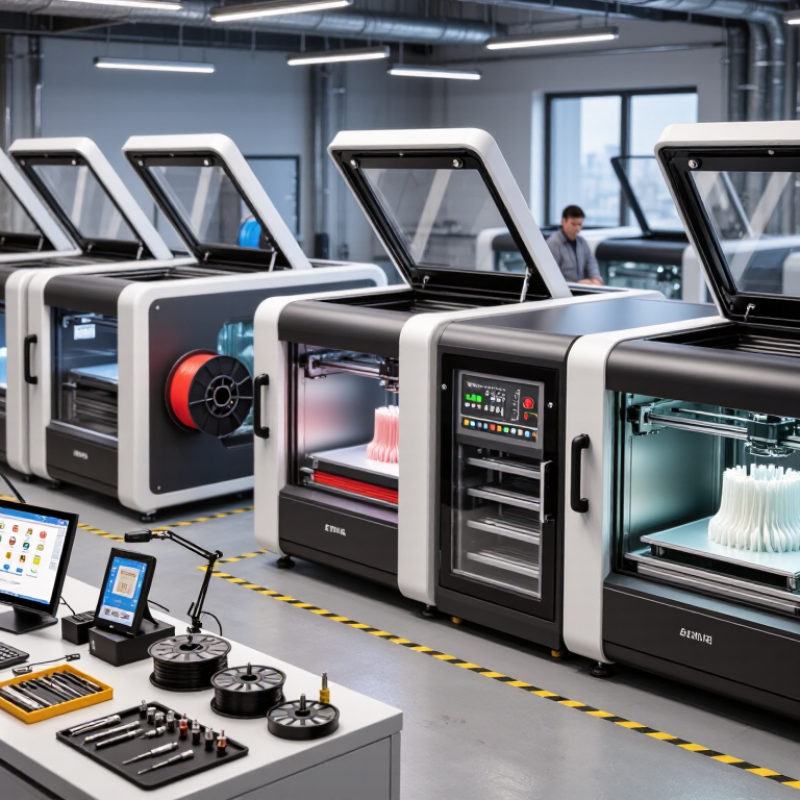
Nylon Printing Requirements for Different Industrial Applications
Nylon printing machines must match the application, not just the material label. Automotive ducts need strong, lightweight parts with smooth internal channels. Industrial jigs need dimensional stability and repeated handling. Aerospace tooling demands traceability, controlled powder storage, and strict process records. Medical fixtures require clean workflows and validated production controls. Each case changes the machine specification.
The 2024 Wohlers Report valued the global additive manufacturing industry at approximately 20.0 billion US dollars in 2023. This growth increases pressure on nylon systems to deliver repeatable output, not impressive samples alone. Buyers should examine build volume, chamber temperature control, cooling consistency, powder refresh rate, and dimensional accuracy. For PA12 production, stable thermal management often matters more than headline speed. For reinforced nylon, filtration and wear-resistant material paths deserve closer inspection.
A machine with a large chamber may suit batch production, but it can waste powder during low-volume work. That is easy to overlook. ISO/ASTM 52900 terminology also supports clearer comparisons between powder-bed fusion systems and other processes. In practice, operators should test thin walls, snap fits, threaded holes, and loaded brackets before purchasing. One test failed in our evaluation because cooling was uneven. The failure was useful. It exposed a weakness that a polished demonstration part concealed.
7 Best Nylon Printing Machines for Global Buyers - Nylon Printing Requirements for Different Industrial Applications
| Machine Type | Printing Technology | Typical Build Volume | Thermal and Process Capability | Suitable Nylon Materials | Recommended Industrial Applications | Important Buying Requirements |
|---|---|---|---|---|---|---|
| Industrial Selective Laser Sintering Machine | Powder-bed fusion using a CO₂ or fiber laser to sinter polymer powder without support structures. | Approximately 200 × 250 × 300 mm to 700 × 380 × 580 mm | Heated powder chamber; precise temperature control; typical layer thickness of 0.08–0.15 mm; no support removal required. | PA12 PA11 Glass-filled PA Aluminum-filled PA | Functional prototypes, snap-fit housings, air ducts, brackets, low-volume production parts, and complex internal channels. | Check laser power, powder refresh ratio, thermal uniformity, inert-gas consumption, cooling time, and availability of validated material profiles. |
| Multi-Agent Powder-Fusion Nylon Printer | Powder fusion using fusing and detailing agents with infrared energy to process an entire layer efficiently. | Approximately 300 × 300 × 300 mm to 380 × 380 × 280 mm | Controlled powder-bed heating; typical layer thickness of about 0.08 mm; high part-packing efficiency and consistent production throughput. | PA12 PA11 TPU Mineral-filled PA | Production components, customized medical devices, consumer-product parts, enclosures, lattice structures, and short-run manufacturing. | Evaluate production rate, powder recycling policy, agent management, automated unpacking, surface finish, dimensional repeatability, and software workflow. |
| High-Temperature Industrial FFF Printer | Fused Filament Fabrication using a heated nozzle to deposit engineering thermoplastic filament layer by layer. | Approximately 300 × 300 × 300 mm to 1,000 × 1,000 × 1,000 mm | Heated build chamber commonly around 60–120°C; nozzle temperatures commonly 300–500°C; heated build platform and controlled cooling are essential. | PA6 PA12 PA-CF PA-GF | Large tooling, jigs and fixtures, replacement parts, robot end-effectors, structural prototypes, and high-temperature functional components. | Confirm chamber temperature, nozzle wear resistance, filament drying system, dual-material support capability, dimensional compensation, and ventilation requirements. |
| Industrial Selective Absorption Fusion Machine | Powder-bed fusion that uses infrared absorbers and thermal energy to fuse polymer powder layer by layer. | Approximately 380 × 284 × 380 mm to 600 × 600 × 600 mm | Full-layer processing with controlled powder heating; suitable for high-volume batch production and dense part nesting. | PA11 PA12 TPU Recycled PA blends | Automotive components, industrial replacement parts, footwear components, customized products, and medium-volume nylon production. | Compare cycle time, material refresh rate, powder handling automation, thermal calibration, nesting software, and compatibility with regional power standards. |
| Continuous-Fiber Nylon Composite Printer | FFF-based printing that combines nylon matrix filament with continuous carbon or glass fiber reinforcement. | Approximately 300 × 200 × 150 mm to 600 × 500 × 500 mm | Heated nozzle and build platform; fiber placement improves stiffness and strength along selected load paths; anisotropic performance must be considered. | PA6-CF PA12-CF PA-GF Short-fiber nylon | Lightweight tooling, robotic grippers, structural brackets, fixtures, drone components, and customized load-bearing prototypes. | Review fiber routing accuracy, matrix-fiber compatibility, nozzle hardness, layer adhesion, build orientation, tensile data, and post-processing options. |
| Large-Format Nylon Pellet Extrusion Printer | Direct extrusion of nylon pellets through a large heated screw or granule extruder. | Approximately 500 × 500 × 500 mm to 2,000 × 1,000 × 1,000 mm or larger | High material deposition rates; heated build environment recommended; typical use involves coarse layers and machining or finishing afterward. | PA6 pellets PA12 pellets Reinforced PA Recycled nylon blends | Large molds, patterns, industrial tooling, transportation components, architectural prototypes, and oversized functional parts. | Assess extrusion rate, pellet drying capacity, screw and nozzle wear, temperature uniformity, material filtration, CNC finishing allowance, and floor-space requirements. |
| Compact Professional Nylon SLS Printer | Compact laser-based powder-bed fusion designed for engineering laboratories and small-batch production. | Approximately 165 × 165 × 300 mm to 250 × 250 × 300 mm | Integrated powder heating and controlled laser scanning; optimized for prototypes and limited production rather than continuous factory output. | PA12 PA11 Flexible nylon blends | Product development, engineering validation, educational laboratories, replacement parts, design studios, and customized low-volume components. | Verify powder refresh procedure, cooling duration, air filtration, chamber accessibility, software usability, calibration frequency, and total operating cost. |
Technical values are representative industry ranges rather than specifications for a particular manufacturer. Actual performance depends on machine configuration, nylon grade, moisture control, build orientation, process parameters, and post-processing. Nylon filament and powder should generally be dried and stored in sealed, low-humidity conditions before printing.