

loading

Our Blog

Check out our innovative pump solutions and industry insights to see what's new in the pumping industry. Stay up to date with the latest trends and news in the world of pumping technology by following our pumping technology blog.

2026 Top Marine Dishwashers for Global Buyers

Choosing the right Marine Dishwasher in 2026 requires more than comparing wash cycles and stainless-steel panels. On a yacht, ferry, research vessel, or offshore support ship, every appliance must handle movement, limited space, salt-laden air, and changing electrical conditions. Space is unforgiving. A model that looks efficient in a showroom may become difficult to service inside a narrow galley.

This guide examines leading marine dishwashers for global buyers through practical operating needs. It considers rack capacity, water consumption, drying performance, noise, vibration resistance, corrosion protection, and installation flexibility. Voltage and frequency compatibility also matter, especially for vessels crossing regions with different onboard power systems. Small details matter. Door clearance, drainage height, spare-parts access, and control-panel visibility can affect daily reliability more than impressive marketing language.

The selections are based on manufacturer specifications, marine-use features, professional product information, and common onboard maintenance concerns. Buyers should still confirm local requirements, vessel wiring, freshwater limits, and available technical support before ordering. A dependable warranty is valuable, but only when the supplier can provide timely assistance near the vessel’s operating area. There is no perfect choice. A compact unit may save space but reduce loading capacity, while a larger model may increase water and energy demands. This comparison aims to make those trade-offs clearer, while acknowledging that real-world performance depends on installation quality, crew habits, and maintenance discipline.
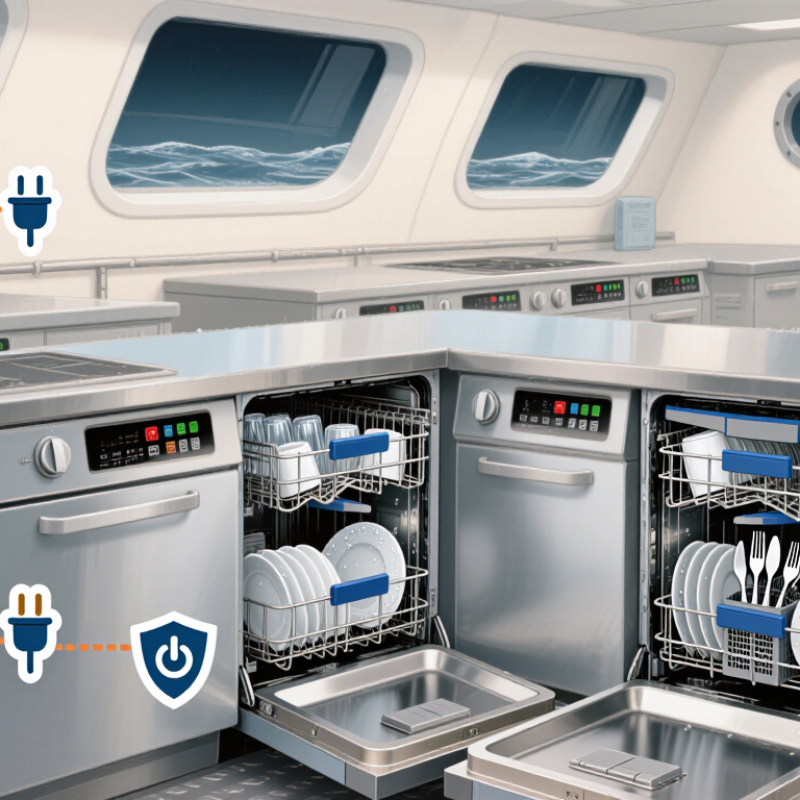
2026 Top Marine Dishwashers for Global Buyers

Marine Dishwasher Basics and Key Applications

Marine dishwashers serve a harsher environment than standard commercial units.
Salt air, vessel movement, limited freshwater, and narrow galley spaces affect daily performance. A suitable unit needs corrosion-resistant construction, stable racks, simple controls, and rapid wash cycles. Drainage matters too. Standing water can create hygiene problems during rough weather.

The World Health Organization estimates that contaminated food causes about 600 million illnesses and 420,000 deaths yearly. This makes reliable dish sanitation essential on ships, offshore platforms, and passenger vessels. The Vessel Sanitation Program also emphasizes controlled food-service hygiene, equipment cleaning, and documented procedures. Operators should check wash temperature, final-rinse performance, detergent dosing, and drying quality. Sensors help, but crew training remains necessary.

Passenger demand is growing. The Cruise Lines International Association reported approximately 37.2 million cruise passengers in 2024. Larger dining operations require equipment that can manage repeated loads without excessive water use. Offshore kitchens need compact machines with accessible filters and easy maintenance. Cargo vessels may prioritize durability over speed. No model is perfect. Energy figures can look impressive, yet real consumption changes with water temperature, loading habits, and maintenance. Buyers should request tested capacity data, service records, and installation requirements before selection.

Essential Features for Shipboard Washing Performance

2026 Top Marine Dishwashers for Global Buyers

Essential Features for Shipboard Washing Performance

Shipboard dishwashers must handle salt air, vibration, hard water, and limited freshwater supplies. A domestic machine rarely survives these conditions for long. Choose marine-grade stainless steel, reinforced racks, secure door latches, and corrosion-resistant heating elements. A 316 stainless-steel wash chamber can offer stronger resistance in humid, saline environments. It still requires cleaning. No material is maintenance-free.

The IMO Fourth Greenhouse Gas Study estimates that shipping produced 2.89% of global human-made carbon emissions in 2018. UNCTAD’s Review of Maritime Transport 2024 also confirms that more than 80% of world merchandise trade by volume moves by sea. These figures support efficient onboard equipment. Look for low-water cycles, heat recovery, insulation, and adjustable programs. NSF/ANSI 3 provides a useful commercial warewashing benchmark for sanitation performance, although vessel operators must also follow flag-state and onboard hygiene procedures. Final-rinse temperature stability matters more than impressive advertising numbers.

Tips: Measure freshwater pressure before purchase. Test the machine during generator changeover. Keep spare pumps, seals, and spray arms onboard. Check noise levels near cabins. A compact unit may save space but reduce hourly capacity. That trade-off deserves honest review. Temperature sensors should be easy to verify, and drain systems must tolerate vessel movement without backflow.

2026 Top Marine Dishwashers for Global Buyers - Essential Features for Shipboard Washing Performance

Dishwasher Configuration Best-Fit Shipboard Use Typical Rack Size Typical Throughput Typical Cycle Time Fresh Water Use Connected Load Key Marine-Ready Features Important Installation Requirements
Compact Undercounter Unit Small vessels, crew galleys, offshore support vessels and low-volume service areas 500 × 500 mm 30–40 racks/hour 90–120 seconds 2–4 L/rack 6–12 kW Stainless-steel wash tank, low-water rinse system, removable filters, automatic detergent and rinse-aid dosing, final rinse temperature monitoring Level deck, potable-water connection, suitable drain air gap, ventilation for heat and humidity, and electrical supply matched to the vessel
Pass-Through Hood Type Medium and large crew galleys requiring fast loading and unloading 500 × 500 mm 60–80 racks/hour 45–90 seconds 2.5–5 L/rack 9–20 kW Lift-up hood, insulated panels, heat recovery option, automatic tank fill, rinse-temperature display, interlocked operation and easy-access spray arms Adequate overhead clearance, non-slip working area, floor drainage, hot-water or booster-heater capacity, and secure mounting for vessel movement
Rack Conveyor Dishwasher Passenger vessels, ferries, cruise-service galleys and other high-volume operations 500 × 500 mm 100–200 racks/hour 18–45 seconds per zone 0.8–2 L/rack 20–50 kW Multi-zone prewash, wash and rinse sections, variable-speed conveyor, soil sensors, heat recovery, automatic dosing and continuous filtration Long, level installation footprint; dedicated drainage; high electrical capacity; ventilation; service access; and structural evaluation for machinery weight and vibration
Utensil and Pot Washer Large galley cookware, trays, mixing bowls, pans and heavily soiled utensils 600 × 500 mm or larger 2–6 baskets/hour 4–10 minutes 10–25 L/cycle 12–30 kW High-pressure wash pump, large-volume tank, heavy-duty spray arms, removable coarse filters, selectable wash programs and robust door seals High-capacity drain, strong hot-water or booster-heater supply, adequate floor loading, splash protection and clearance for large cookware
Compact Glasswasher Bars, lounges, passenger service areas and small hospitality spaces onboard 400 × 400 mm 30–60 racks/hour 60–120 seconds 2–3 L/rack 4–9 kW Gentle wash program, low-temperature option where permitted, insulated chamber, fine filtration, rinse-aid dosing and glass-safe rack design Stable counter or deck, controlled water hardness, suitable drain arrangement, splash containment and protection from direct vessel vibration
Modular Multi-Tank System High-capacity galleys needing separate prewash, wash, rinse and drying stages 500 × 500 mm 150–300 racks/hour 12–30 seconds per zone 0.6–1.5 L/rack 30–70 kW Configurable conveyor length, independent tank controls, automatic soil removal, rinse-water recirculation, drying section, heat recovery and digital fault logging Detailed galley layout, dedicated power distribution, drainage and ventilation design, service access on both sides where required, and approved securing points
Buyer checklist: Confirm the vessel’s electrical frequency and voltage, potable-water pressure, water hardness, drainage arrangement, ventilation capacity, available floor area, equipment securing method, spare-parts support and applicable maritime approval requirements. Performance values shown are typical specification ranges and should be verified against the final equipment configuration and onboard operating conditions.

2026 Buying Criteria for Global Marine Dishwasher Buyers

2026 Top Marine Dishwashers for Global Buyers

Marine dishwasher selection requires more than checking washing capacity. Global buyers should match the machine to vessel size, galley workload, crew routines, and available installation space. Measure door clearance carefully. A compact unit may fit poorly beside a moving worktable.

Corrosion resistance is essential in humid, salt-filled environments. Look for marine-grade stainless materials, sealed controls, reinforced racks, and reliable drainage. Check electrical compatibility before purchase, including voltage, frequency, phase, and connection requirements. Water consumption also matters on vessels with limited freshwater systems. Strong cleaning performance is useful, but excessive heat may increase energy demand and damage sensitive tableware. Ask for documented test results, safety information, warranty terms, and service support in your destination region. A low purchase price can become expensive when spare parts travel slowly. I have seen specifications look impressive, yet daily loading space was overlooked.

Tips: Measure twice. Confirm local requirements. Request spare-part lists. Test rack movement with real plates and cups. Ask whether technicians can support your route and port schedule. Do not rely only on catalog photographs.

Noise and vibration deserve practical attention. A dishwasher that rattles during rough seas can disturb rest areas and loosen nearby fittings. Choose adjustable feet, stable mounting options, and accessible filters. Installation instructions should be clear for international crews. However, no checklist is perfect; crew habits and cleaning quality still influence results. A short trial with actual galley items may reveal problems that technical documents miss.

2026 Top Marine Dishwashers for Global Buyers

2026 buying criteria for global marine dishwasher buyers. The chart presents an indicative 100-point evaluation framework based on practical vessel galley requirements, including hygiene, resource efficiency, durability, installation, and operational reliability.

Higher percentages indicate greater importance in a balanced procurement assessment. Actual weighting should be adjusted for vessel type, crew size, available utilities, classification requirements, and onboard operating procedures.

Top Marine Dishwasher Types by Vessel and Operating Needs

For global buyers, marine dishwashers should match the vessel, not just the galley size. UNCTAD’s Review of Maritime Transport 2024 states that ships carry over 80% of global merchandise trade by volume. Cargo vessels therefore need compact, dependable units that tolerate vibration and irregular port schedules. A 230-volt model may suit many international ships, but electrical frequency still requires verification.

Passenger and cruise vessels face heavier peaks. They may wash hundreds of plates after one dining service. High-throughput rack systems, heat recovery, and short cycles reduce queue time near the galley. The CDC Vessel Sanitation Program stresses effective cleaning, sanitizing, and safe food-service practices aboard passenger ships. Temperature records and simple operator controls matter. Space is limited.

Offshore vessels and workboats need different priorities. Their crews may operate far from shore, with restricted freshwater and strict maintenance windows. Low-water programs, stainless-steel interiors, spare-part access, and strong filtration become practical advantages. DNV’s Maritime Forecast to 2050 highlights efficiency and operational resilience as continuing maritime priorities. Energy use deserves attention, although published comparisons often use different test conditions. No selection is perfect. I would still test rack fit, drainage during vessel motion, noise beside cabins, and cleaning results with actual galley soil before purchasing.

Installation, Maintenance, Safety, and Compliance Considerations

2026 Top Marine Dishwashers for Global Buyers

Installation, Maintenance, Safety, and Compliance Considerations

Marine dishwasher performance begins with a level, reinforced mounting surface. Even a slight tilt can leave water inside the wash chamber. Confirm the vessel’s voltage, frequency, freshwater pressure, drain height, and available space before delivery. Flexible connections should resist vibration but remain accessible for inspection. In practice, perfect installation is rare. A trial fit often reveals problems that drawings miss.

Maintenance must match the vessel’s operating rhythm. Remove food particles from filters after each busy service period. Inspect spray arms weekly for blocked jets, scale, or loose fittings. Check door seals and chemical lines regularly. Keep a simple log of temperatures, faults, cleaning tasks, and replacement parts. This evidence helps engineers identify repeated failures. It also supports reliable service planning. Do not ignore small leaks.

Safety controls deserve direct attention. Operators need clear instructions for hot surfaces, steam, detergents, and emergency isolation. Non-slip flooring should surround the machine, especially near a rolling sea. Electrical protection, grounding, and cable routing must suit the marine environment. Wastewater discharge should follow the vessel’s operating area and applicable local requirements. Buyers should request technical files, test records, material information, and conformity documents before acceptance. Requirements may differ between commercial vessels, offshore units, and passenger ships. That difference is easy to overlook.