

loading

Our Blog

Check out our innovative pump solutions and industry insights to see what's new in the pumping industry. Stay up to date with the latest trends and news in the world of pumping technology by following our pumping technology blog.

2026 Top Electric Panel Box Manufacturers and Suppliers

As electrical distribution demands grow, the right Electric Panel Box manufacturer can influence safety, uptime, and installation efficiency. In 2026, buyers face a crowded market filled with established factories, regional specialists, and newer suppliers. This guide examines leading manufacturers and suppliers through practical purchasing criteria. It considers enclosure materials, thermal performance, ingress protection, wiring space, customization, and production consistency. These details matter inside a busy plant, where heat, dust, vibration, and limited maintenance access can quickly expose weak design choices.

Safety remains central.

Reliable suppliers should provide clear technical drawings, traceable materials, documented testing, and responsive engineering support. Relevant certifications and conformity records deserve careful review, not casual acceptance. A polished website cannot replace factory audits, sample inspections, or verified customer references. Delivery schedules also need scrutiny. A low quoted price may become expensive when components arrive late or replacement parts are unavailable. The strongest suppliers usually explain tolerances, inspection procedures, warranty limits, and after-sales responsibilities before signing contracts.

No supplier is perfect.

Specifications can look impressive and still hide practical limitations. Some manufacturers may offer excellent customization but struggle with small-batch delivery. Others may provide fast production but limited design support. Buyers should compare total value rather than headline pricing alone. This 2026 overview offers a structured starting point for contractors, distributors, OEMs, and facility managers. It also encourages critical thinking, because regional codes, project conditions, and future expansion plans can change the best choice. Careful verification remains essential.
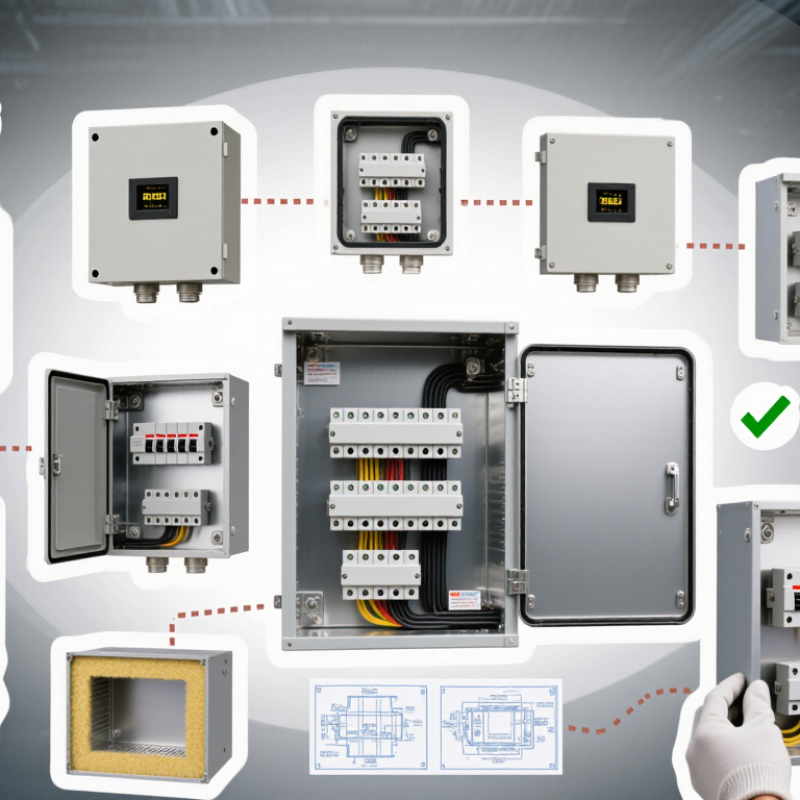
2026 Top Electric Panel Box Manufacturers and Suppliers

What Is an Electric Panel Box and How Does It Work?

An electric panel box is the control center for a building’s electrical system. It receives power from the utility service and distributes it to lighting, outlets, appliances, and dedicated equipment. Inside, a main breaker controls the incoming supply. Copper or aluminum bus bars then carry electricity to individual circuit breakers. Each breaker protects one branch circuit from excessive current.

When a circuit draws too much power, its breaker trips and opens the circuit. This action limits heat buildup in the wiring and lowers fire risk. Some panels also use specialized protection against ground faults or arc faults. The neutral bar returns current to the source, while the grounding bar provides a safer path during a fault. These parts must remain correctly separated and securely connected.

A quality panel box should have clear labels, durable terminals, adequate capacity, and enough room for future circuits. A practical inspection should check for loose wires, scorch marks, moisture, and repeated breaker trips. Labels are not always accurate. That small detail can create a serious service mistake. Never remove the cover or test live parts without proper training and approved procedures. Even a quiet panel may contain dangerous voltage. In real installations, neat wiring helps, but neatness alone does not prove safety. Load calculations, conductor size, breaker ratings, and local electrical requirements must match. This is where inexperienced selection often fails. A qualified electrician can verify compatibility before installation or replacement.

Key Standards and Features for Evaluating Electric Panel Boxes

As global electricity demand grows, panel reliability becomes harder to treat as a paperwork issue. The IEA’s Electricity 2024 report projects average annual demand growth of 3.4% through 2026. That increase raises pressure on distribution equipment, especially in crowded commercial rooms.

For buyers, compliance starts with IEC 61439 verification, not attractive doors or oversized labels. The standard addresses temperature rise, short-circuit withstand, clearances, and dielectric performance. A panel should also match IEC 60529 ingress protection requirements. Dust and water enter through small mistakes. UL 50/50E and NEMA enclosure classifications provide additional guidance for environmental protection. However, ratings are not interchangeable. Confirm the test basis, installation location, and intended exposure before comparing suppliers.

Thermal management deserves close inspection. Check busbar spacing, ventilation, conductor capacity, and accessible cable routes. NFPA’s Electrical Fires report estimates about 33,900 U.S. structure fires annually involved electrical distribution or lighting equipment from 2015 to 2019. Poor termination can become a hot spot. Use torque-controlled connections and request documented inspection records. Copper or aluminum conductors also require compatible terminals and careful tightening. Clear circuit identification improves maintenance speed. I would not trust a panel because it looks clean. A neat enclosure can still hide weak airflow, poor labeling, or unverified components. Evaluation is rarely perfect. That uncertainty should be recorded, not ignored.

Leading Electric Panel Box Manufacturers in 2026

Leading Electric Panel Box Manufacturers in 2026

Leading electric panel box manufacturers in 2026 are judged by more than catalog size. Experienced suppliers design enclosures for heat, dust, moisture, vibration, and limited installation space. Their engineers select steel, stainless steel, or reinforced polymer according to the site environment. A factory floor needs different protection from a clean indoor control room.

Clear engineering evidence matters. Reliable manufacturers provide enclosure ratings, material thickness, busbar capacity, wiring space, and verified temperature performance. They also support short-circuit testing, grounding continuity, insulation checks, and documented quality control. Look for traceable production records. Ask how suppliers manage design changes, replacement parts, and delivery delays.

Small details often expose weak production. Poor door alignment can damage gaskets. Crowded terminals can slow maintenance and increase wiring mistakes. A strong supplier leaves practical clearance around breakers and cable entries. Custom layouts may reduce wasted space, but they can complicate future upgrades. That trade-off deserves honest discussion.

In 2026, dependable manufacturers are improving digital design, modular assemblies, and remote inspection processes. These tools can shorten approval cycles and reduce drawing errors. Still, software cannot replace physical testing. I have seen attractive specifications fail when ventilation was ignored. Buyers should compare tested performance, service response, and installation guidance, not just price. Supplier reliability becomes visible after the shipment arrives.

Major Electric Panel Box Suppliers and Their Distribution Strengths

The 2026 electric panel box market is becoming more regional, responsive, and specification-driven. Grand View Research estimates the global switchgear market will expand at about 7% annually through 2030. This growth supports demand for safer enclosures, modular assemblies, and faster replacement programs.

Major suppliers differ mainly through distribution strength. Large manufacturers often maintain regional warehouses, technical teams, and established contractor networks. These resources reduce delivery risks for data centers, factories, and residential developments. Smaller suppliers can compete through short production runs and custom layouts. Their advantage is often closer communication with installers. That matters when cable entry, heat dissipation, or space limits change late.

Reliability still depends on more than inventory. Panel boxes should align with applicable IEC 61439 requirements or relevant national standards. Certification documents, traceable components, and clear installation instructions build practical trust. The International Energy Agency reported that global electricity demand could grow by more than 3% annually during 2024–2026. More electrical loads will pressure distribution systems and service capacity. However, market reports do not always define “panel box” consistently. Comparisons can therefore mislead buyers. A supplier with broad coverage may not offer the best local support. Site visits, sample inspections, and response-time testing remain useful before large contracts. Small details matter.

2026 Top Electric Panel Box Manufacturers and Suppliers - Major Electric Panel Box Suppliers and Their Distribution Strengths

Comparative market reference table based on commonly published electrical enclosure standards, product configurations, and regional distribution models.

Supplier Category Primary Product Scope Common Enclosure Ratings Typical Voltage and Current Range Applicable Standards Distribution Strength Typical Standard Lead Time Best-Fit Applications
Global low-voltage panel specialists Main distribution boards, feeder panels, motor-control panels, and modular switchboards NEMA 1, NEMA 3R, NEMA 12; IP31 to IP55 Up to 1,000 V AC; approximately 100–4,000 A IEC 61439, IEC 60529, UL 50/50E, NEMA 250 Multi-country distributor networks, authorized electrical wholesalers, and project-based system integrators 4–10 weeks for configured standard assemblies Commercial buildings, factories, infrastructure, and utility support systems
Regional industrial enclosure manufacturers Wall-mounted control boxes, floor-standing cabinets, junction boxes, and operator panels NEMA 3R, NEMA 4, NEMA 12; IP54 to IP66 Up to 690 V AC; approximately 16–1,600 A IEC 62208, IEC 60529, IEC 61439, NEMA 250 Strong domestic stock availability, metalworking customization, and local engineering support 2–8 weeks, depending on fabrication and component configuration Machine building, process control, water treatment, and manufacturing plants
Stainless-steel hygienic enclosure suppliers Washdown-rated control cabinets, stainless junction boxes, and hygienic operator stations NEMA 4X; IP66 to IP69K where specified Up to 600 V AC; approximately 10–1,200 A IEC 60529, NEMA 250, UL 50E, applicable food-equipment hygiene requirements Specialist food, beverage, pharmaceutical, and clean-process distribution channels 5–12 weeks for custom stainless-steel assemblies Food processing, beverage lines, pharmaceutical production, and corrosive environments
Outdoor utility and infrastructure panel suppliers Outdoor distribution cabinets, feeder pillars, metering panels, and service disconnect enclosures NEMA 3R, NEMA 4X; IP55 to IP66 Up to 1,000 V AC; approximately 100–2,500 A IEC 61439, IEC 60529, NEMA 250, local utility specifications Public-infrastructure contractors, utility procurement frameworks, and regional project warehouses 6–16 weeks for engineered outdoor assemblies Transport systems, renewable-energy sites, water utilities, and public distribution networks
Modular commercial panelboard suppliers Lighting panels, branch-circuit panels, small distribution boards, and modular meter centers NEMA 1 and NEMA 3R; IP30 to IP54 120–600 V AC; approximately 100–1,200 A IEC 61439, UL 67, UL 891, NEMA PB 1 High-volume electrical wholesalers, contractor counters, and online industrial distribution 1–6 weeks for standard configurations Offices, retail facilities, apartments, schools, and light commercial projects
Renewable-energy and battery-system enclosure suppliers Solar combiner boxes, battery protection panels, inverter cabinets, and energy-storage switchboards NEMA 3R, NEMA 4, NEMA 4X; IP54 to IP66 Up to 1,500 V DC and 1,000 V AC; approximately 100–2,000 A IEC 61439, IEC 60529, UL 1741, UL 9540-related system requirements where applicable Solar installers, energy-storage integrators, EPC contractors, and regional renewable-energy distributors 4–14 weeks, depending on protection devices and monitoring requirements Solar farms, commercial storage, microgrids, and electric-vehicle infrastructure
Hazardous-area panel enclosure suppliers Explosion-protected control stations, certified junction boxes, and hazardous-location distribution panels IP54 to IP66; certified flameproof or increased-safety designs Up to 1,000 V AC; approximately 16–1,600 A IEC 60079 series, ATEX, IECEx, NEC hazardous-location requirements Specialist distributors, oil-and-gas integrators, and certified industrial project contractors 8–20 weeks because of certification and engineering review Oil and gas, chemical processing, mining, and combustible-dust environments
Custom-engineered project panel suppliers Integrated switchgear lineups, automation panels, synchronizing panels, and engineered control systems NEMA 1, NEMA 3R, NEMA 12, NEMA 4X; IP31 to IP66 Up to 1,000 V AC; approximately 400–6,300 A IEC 61439, UL 1558, UL 891, NEMA SG 5, project-specific utility standards Engineering-procurement-construction channels, approved-vendor lists, and turnkey project delivery 10–28 weeks for fully engineered systems Data centers, heavy industry, power generation, airports, and large infrastructure projects
Compact OEM control-box suppliers Small machine-control boxes, push-button stations, PLC cabinets, and interface enclosures NEMA 1, NEMA 4, NEMA 4X; IP54 to IP66 Up to 600 V AC; approximately 6–400 A IEC 60204-1, IEC 60529, IEC 61439, NEMA 250 OEM catalogs, machine builders, panel shops, and rapid online component distribution 1–5 weeks for catalog products; 3–8 weeks for modified units Packaging equipment, conveyors, robotics, machine tools, and factory automation
Plastic and polycarbonate panel-box suppliers Non-metallic junction boxes, distribution boxes, instrumentation cabinets, and corrosive-area enclosures NEMA 3R, NEMA 4, NEMA 4X; IP65 to IP67 Up to 600 V AC; approximately 10–800 A IEC 60670, IEC 60529, NEMA 250, UL 50E where applicable Broad stock coverage through electrical wholesalers and corrosion-resistant product distributors 1–6 weeks for standard products Marine facilities, wastewater treatment, agriculture, chemical handling, and outdoor instrumentation
Reference note: The figures shown are non-company-specific market ranges and specification benchmarks. Actual ratings, certifications, stock levels, delivery times, and regional availability vary by configuration, country, project requirements, and applicable electrical codes.

How to Select the Right Manufacturer or Supplier for Your Project

Choosing the right electric panel box manufacturer or supplier requires more than comparing prices. Start with your project’s voltage, enclosure size, installation environment, and expected production volume. A reliable supplier should explain material thickness, corrosion resistance, ingress protection, thermal performance, and customization limits clearly. Ask for current test reports, inspection records, dimensional drawings, and traceable material documents.

Factory experience matters. Review similar projects, production equipment, quality controls, and engineering support before signing an agreement. If possible, inspect a sample panel box directly. Check door alignment, hinge strength, gasket compression, grounding points, weld quality, and internal clearance. A polished catalog proves very little. I have learned that small defects often appear during installation, not during a sales presentation. Lead time, minimum order quantity, replacement support, and change-control procedures also deserve written confirmation. One overlooked detail can delay an entire control system.

Tips

Request a sample before bulk production. Compare it with the approved drawing. Confirm testing methods and acceptance criteria in writing. Ask how the supplier handles design changes, damaged shipments, and urgent replacements. Do not choose the lowest quote automatically; a cheaper enclosure may require extra machining, rewiring, or field repairs. Speak with an independent engineer when the application involves heat, moisture, dust, or frequent maintenance. Reliability is built through evidence, not confident promises.

2026 Top Electric Panel Box Manufacturers and Suppliers: How to Select the Right Manufacturer or Supplier for Your Project

Enclosure protection is a practical specification when comparing electric panel box manufacturers and suppliers. The chart below compares common IP ratings using the IEC 60529 coding system.

The first digit indicates protection against solid objects and dust, from level 0 to 6. The second digit indicates protection against water, from level 0 to 9. When selecting a supplier, confirm that the proposed panel box rating, materials, sealing system, testing documentation, and compliance requirements match the installation environment.